Guide to Virginia Marriage Records
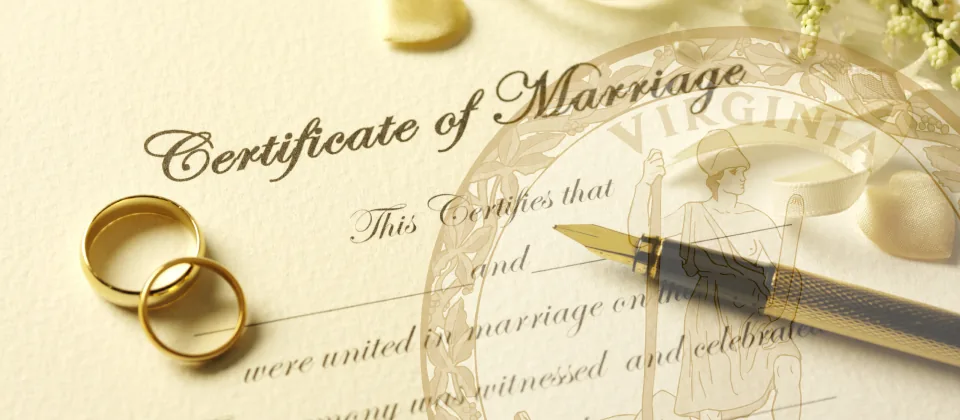
Marriage records in Virginia are official government documents attesting that the persons named on the records are legally married in the state. The information found in Virginia marriage records includes the couple's names, the date of marriage, the county or city of marriage, the marriage license number, and the name of the officiant. Marriage records are maintained by the Virginia Department of Health, Office of Vital Records, and the circuit court clerk in the county where the license was obtained.
Although marriage records, marriage certificates, and marriage licenses are related, they are different documents. A marriage license is an official document issued before a wedding to authorize a couple to get married. A marriage certificate is a document created after the wedding when the officiant returns the signed license to the clerk’s office to confirm the marriage. However, “marriage record” is an umbrella term that encompasses both the marriage license and the marriage certificate, as well as any searches conducted in vital records databases.
Virginians search and obtain marriage records for different purposes, including the following:
- Legal purposes: Establishing eligibility for government benefits, immigration visas, or tax filings.
- Genealogy and family history: Mapping lineages through archival lineage lines
- Name changes: Providing foundation proof to modify a surname
- Divorce or estate matters: Validating or dissolving asset rights during probate or marital splits
Types of Marriage Records in Virginia
| Record Type | Purpose | Issued by | Validity/Notes |
|---|---|---|---|
| Marriage License | Authorization to marry | Clerk of a Virginia circuit court | Valid for 60 days. |
| Marriage Certificate | Official proof that the marriage occurred | Virginia Office of Vital Records or the circuit court clerk that issued the license | Official proof of marriage for legal and administrative purposes. |
| Genealogical Marriage Record | Historical and family history research | Virginia Office of Vital Records and the Library of Virginia | Available for records older than 25 years. |
Marriage records in Virginia are commonly available to requesters in the following forms:
Marriage Certificates
A marriage certificate is a certified document proving that a marriage ceremony took place under authorized oversight in Virginia. The contents of this type of marriage record include the names of the spouses, date of marriage, county of marriage, marriage license number, and officiant names.
Certified copies of Virginia marriage certificates are required to change a name on a Social Security card, apply for a spousal visa, add a spouse to health insurance, or file certain tax or estate documents.
The Office of Vital Records of the Virginia Department of Health issues certified copies of marriage certificates. In addition, the circuit court clerk in the city or county where the marriage license was originally issued may also issue certified copies of Virginia marriage certificates.
Marriage Licenses
A marriage license is a legal permit authorizing a couple to marry within state lines. It serves as an initial authorization, unlike a marriage certificate, which confirms the solemnization of a marriage. A Virginia marriage license expires 60 days after issuance.
Are Marriage Records Public in Virginia?
Virginia marriage records become public only 25 years after the date of the marriage. Until that period passes, the records are only accessible to eligible individuals identified under Virginia Code § 32.1-271. These include the spouses named on the record and family members, such as parents, children, siblings, and grandparents, upon submission of proof of a familial or legal relationship to the couple.
Also, legal representatives and authorized government agencies may obtain information when their authority satisfies applicable requirements. Older records are accessible to genealogists and researchers and are freely searchable, while recent marriages require proof of eligibility to obtain a certified copy.
What Information Is Included in a Marriage Record?

A Virginia marriage record may include:
- Full names of both spouses
- Date and place of marriage
- Court clerk or marriage record number
- Ages, dates, and places of birth
- Residences of the spouses
- Parents' names
- Previous marital status and number of previous marriages
- Officiant's name, title, signature, and address
- Date the license was issued and returned
- State file number
Under Virginia law, Social Security numbers and DMV identification numbers collected during marriage-license applications are not disclosed to the public.
How to Find Marriage Records in Virginia
Step 1: Identify the Marriage Details
Collect the full legal and maiden names of the couple and determine the exact or approximate calendar date of the wedding. You may also need to narrow down the specific city or county where the marriage license was filed.
Step 2: Find the Record Custodian
Depending on the age of the record desired, the custodian may be the Office of Vital Records, the clerk of the circuit court, or the Library of Virginia. The VDH-DVR manages all records from 1853-1896 and June 14, 1912, to the present.
Step 3: Choose How to Search
To obtain marriage records, requesters may use available options, including the state's online portal, mail-in requests, in-person visits, and third-party tools. Virginia also contracts with a third-party vendor (VitalChek) for expedited online ordering.
Step 4: Submit a Record Request
Marriage record applications typically require submitting a form, a government-issued ID, and a $15 fee. Records requested online from the Office of Vital Records typically take 5 business days to process, while mail-in requests take about 8 business days. These timelines exclude delivery time.
Requesters who need a marriage record for legal use should request a certified copy. Note that availability and fees for uncertified copies from circuit courts in the state vary by court and depend on local procedures.
How to Get a Certified Marriage Certificate in Virginia
Persons seeking to obtain a certified Virginia marriage certificate for a marriage record less than 25 years old may submit an application online, by mail, or in person to the Office of Vital Records. However, they must be a spouse named on the record or a qualifying immediate family member with valid identification. Virginia's ID requirements allow certain primary identification or qualifying combinations of secondary documents.
Certified marriage records are also available at the Virginia DMV customer service centers, while expedited ordering is available through VitalChek. Completed mail applications must be sent to:
Virginia Department of HealthDivision of Vital Records
2001 Maywill Street,
Suite 101
Richmond, VA 23230
The state Vital Records fee is $15 per certificate or search. DMV charges the $15 vital record fee plus a $2 DMV processing fee. Additional service and shipping charges apply when using VitalChek. The DMV charges a $17 records search fee for in-person requests processed at a DMV customer service center.
In-person requests are generally fulfilled on the same day, while mail and online applications take longer, depending on the volume of requests before the record custodian.
How to Get a Marriage License in Virginia
Virginia marriage licenses are issued by the clerk of a circuit court in any Virginia county or independent city. There are no residency requirements for marriage license applicants in the state. Furthermore, both parties must be at least 18 years old to apply for a Virginia marriage license. Minors aged 16-17 require a certified birth certificate, a parent's signature, and a court order.
Virginia requires that the information provided on the license application be given under oath. Note that circuit court procedures may vary, but courts typically require a valid government-issued photo ID, such as a driver's license or passport. No waiting periods are required for a marriage license in the state.
A standard marriage license fee in Virginia is $30, consisting of the $20 state marriage license tax and the additional statutory clerk's fee. Once a marriage license is issued, it remains valid for 60 calendar days.
Virginia marriage ceremonies must be performed by a person authorized to solemnize marriages in the state. Such persons include an authorized minister, judge, qualifying public official, or court-authorized civil celebrant. After the ceremony, the officiant must complete the marriage record and return it to the issuing officer within 5 days.
Who Can Request Marriage Records?
For a marriage record under 25 years, the Division of Vital Records permits access to:
- Either spouse named on the record
- Qualifying immediate family members, including parents, current spouses, children, siblings, and grandparents
- A legal representative acting with appropriate authority
- Government agencies requesting information for authorized official purposes
- Other parties who have legal authority, such as an applicable court order
Genealogists and researchers may freely access marriage vital records once the 25-year confidentiality period has expired. Furthermore, the rules differ for circuit court marriage license records, which are generally public, subject to restrictions on protected information such as Social Security numbers.
Free and Online Marriage Record Searches

Anyone can search Virginia marriage records older than 25 years for free on the following platforms:
- Virginia Office of Vital Records genealogy resource: This platform provides access to public historical marriage records, including records from 1936, as they become eligible for public release.
- Library of Virginia's digital collections: This tool also provides historical research resources for Virginia marriage records.
- FamilySearch: This resource offers free access to many digitized historical marriage records from Virginia.
These public lookup tools provide free access to marriage record details, such as names, approximate dates, and filing counties. While they confirm a record's existence, marriage records obtained from these sources do not provide a certified, legally usable copy. Requesters who need a certified copy for legal, governmental, or financial purposes must purchase one through the Office of Vital Records or the relevant circuit court clerk.
Anyone seeking a record but does not know the exact date or locality may begin the search with the spouses' names and an approximate time period in historical indexes or local circuit court records.
Common Law Marriage in Virginia
Virginia does not recognize common-law marriages created within its borders. Hence, cohabitation, shared property, and verbal agreements do not create a legal marriage in the state. Therefore, common-law unions do not have local filing ledgers with state or local authorities and cannot be searched.
However, Virginia recognizes valid common-law marriages established in states where such unions are legally authorized.
How to Correct an Error on a Marriage Record
Correcting a marriage record in Virginia is only open to one of the spouses named on the record. However, in some cases, a legal representative of either spouse may file an amendment application on their behalf. Commonly corrected errors include incorrect dates, misspelled names, wrong county listings, or typographical mistakes made by the officiant or clerk when completing the license.
Some required documentation when submitting an amendment application may include a birth certificate, Social Security card, or other government-issued ID related to the error to be corrected.
Amendments to Virginia marriage record applications are handled by the circuit court where the marriage license was originally issued. Once the circuit court makes the correction, it sends the corrected record to the State Registrar to amend the state record.
Virginia does not impose a statewide fee or processing timeline for marriage-record correction applications. Hence, requesters should contact the appropriate circuit court clerk's office for information on the applicable fees, forms, and processing times.
Marriage Records and Name Changes
A marriage certificate is an important document for a legal name change application. For instance, the Virginia DMV accepts marriage documentation when updating a person's name on DMV records.
Beyond its use in DMV record updates, a marriage certificate can also be submitted to the Social Security Administration as proof of a legal name change. Similarly, the U.S. Department of State may require an original or certified marriage certificate when changing a name on a passport.
However, changing a person's name after marriage is not the same as correcting errors on a marriage record. While a name change updates the person's records with agencies such as DMV and passport agencies, it does not alter the information on the original marriage record. Note that corrections to a Virginia marriage record must be processed through the circuit court that issued the marriage license.
Marriage Records for Genealogy and Family History
Virginia marriage records are useful for genealogical purposes, as historical records may reveal information about spouses, parents, places of residence, birthplaces, ages, and marriage locations.
The Library of Virginia offers historical marriage-related information, including copies of marriage records from before 1936 and marriage bonds from before vital registration began in 1853.
Some historical marriage records are also available online through Virginia genealogy resources and Ancestry. Marriage records are made public after 25 years, while older materials may also be researched on microfilm at the Library of Virginia. According to VDH, there is no charge for viewing microfilms at the Library.
Historical marriage record databases may be searched using one of the spouses’ names and narrowed down by the marriage year, county, independent city, and other known details. If the exact location is unknown, statewide indexes can help identify the Circuit Court or locality that created the record.
Note that older records may contain incomplete details, as statewide civil registration began only in 1853. Some early marriage records were also lost to war, fire, or poor preservation. Hence, the availability of records may vary from one locality to another.
Frequently Asked Questions
Are marriage records public in Virginia?
They are confidential for 25 years after the marriage date, after which they become open public records.
How can I find a marriage record by name?
Search public genealogy databases for older records or submit an application to the VDH Office of Vital Records.
Can I search marriage records online for free?
Yes, indexes for records older than 25 years can be searched for free through historical partner websites.
How much does a marriage certificate cost?
The statutory fee is $15.00 per copy or search through the state vital records office.
How long does it take to get a certified marriage certificate?
In-person visits provide same-day service, while mail or online orders can take several weeks.
Can someone else request my marriage certificate?
Only immediate family members can request restricted records; anyone can request records older than 25 years.
What is the difference between a marriage license and certificate?
A license is the legal permit required to get married, while a certificate is the document that proves the ceremony took place.
Table of Contents
- Types of Marriage Records in Virginia
- Are Marriage Records Public in Virginia?
- What Information Is Included in a Marriage Record?
- How to Find Marriage Records in Virginia
- How to Get a Certified Marriage Certificate in Virginia
- How to Get a Marriage License in Virginia
- Who Can Request Marriage Records?
- Free and Online Marriage Record Searches
- Common Law Marriage in Virginia
- How to Correct an Error on a Marriage Record
- Marriage Records and Name Changes
- Marriage Records for Genealogy and Family History
- Frequently Asked Questions